

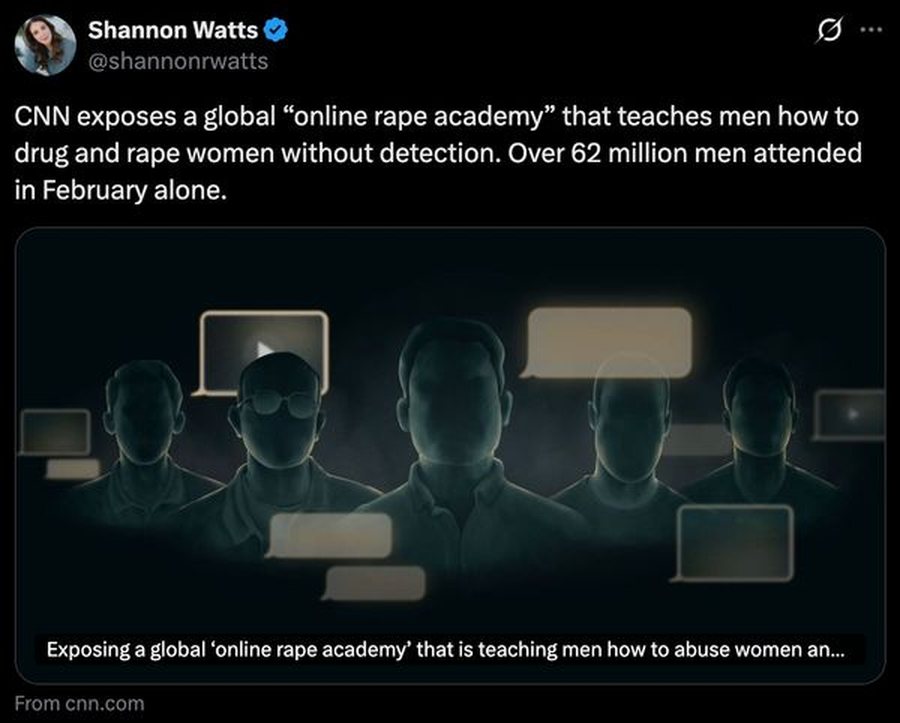
An investigation published on March 26 by CNN's investigative series, "As Equals," has revealed the existence of a secret online network where, according to the report, some users share, organize and discuss forms of sexual abuse against their wives and spouses who are drugged or asleep.
The "As Equals" series focuses on gender inequality and this time has addressed one of the most disturbing forms of violence facilitated by the internet and sedative substances.
The case that made the issue international
The investigation begins with a shocking case in France: that of Dominique Pelicot, who in 2024 admitted in court that he had drugged his wife, Gisèle Pelicot, rendering her unconscious and then invited dozens of men (over 80) to rape her.
According to investigations, the organization of these meetings was done through an online space called "Without Her Knowledge".
This case became symbolic of a broader problem: the way the internet can be used to organize and normalize sexual abuse.
What is "sleep content"?
CNN discovered that on some pornographic platforms and video-sharing sites there is a category called "sleep content", which features women who appear unconscious or drugged.
One of the sites mentioned in the investigation is Motherless.com , which:
- has had millions of monthly visits (over 60 million) according to online analytics estimates
- described as a platform where "anything legal" can be uploaded
- contains over 20,000 videos categorized as "sleep content"
In these videos, tags like:
#passedout (unconscious)
#eyecheck (eye check to show that the person is asleep or unconscious)
In some cases, men are shown lifting women's eyelids to prove they are not conscious. Some videos have received hundreds of thousands of views.
How do these pages relate to online groups?
According to the investigation, some users of these platforms also connect to closed communication groups, including the Telegram application, where small chat rooms with hundreds or thousands of members exist.
In one of these groups called "Zzz", CNN journalists infiltrated it by posing as new users to understand how these communities work.
Within these spaces, according to the report:
- users exchange "tips" for drugging their partners
- discuss doses and substances
- talk about avoiding detection
CNN emphasizes that it has not published names or details that could help identify the specific substances mentioned.

“Online Rape Academy”
The term "online rape academy" was used by French politician Sandrine Josso, who herself was a victim of drug abuse.
She described these groups as:
“The school of violence where all the 'subjects' are taught to become a better rapist.”
According to her, these online spaces are not simply places where content is shared, but also where abusive behavior is normalized and taught.
CNN's investigation and other investigative sources, including German journalists Isabell Beer and Isabel Ströh, show that:
- anonymity on the internet facilitates the creation of these communities
- content can be shared quickly and deleted easily
- some platforms fail to effectively control user-uploaded content
Online traffic analyses (such as those from digital marketing companies) show that such sites can have millions of monthly visits, although these figures are estimates and not absolute accuracy.
Victims' testimonies
The CNN report also includes testimonies from women who say:
- have been drugged by their partners without their knowledge
- were abused while unconscious
- had no memories of the events until they discovered evidence later
The Pelicot case served as a starting point to show that these behaviors are not isolated, but part of a broader and extremely worrying global problem.


